





Imagine you need to move quickly: an unexpected price swing in BTC, a margin call warning on your perpetuals, and you’re on a coffee break with only your phone. You try to log into your exchange, but a delayed SMS 2FA, a clumsy mobile layout, or a frozen chart costs you time. These everyday frictions—login methods, interface latency, credential risk—matter as much as fees or leverage when real money is on the line. This article walks a US-based trader through the mechanics of OKX login, the operational differences between OKX spot (including margin) and futures, and the trade-offs that determine which mode fits a given strategy and risk tolerance.
My aim is analytical and skeptical: highlight what works, what breaks, and what to watch next. Where possible I translate platform features into decision heuristics you can reuse—how to choose a login path, when to prefer spot over futures, and when margin is a useful tool versus a hazard. I’ll also point to the single official entry page that helps with web login procedures and troubleshooting.
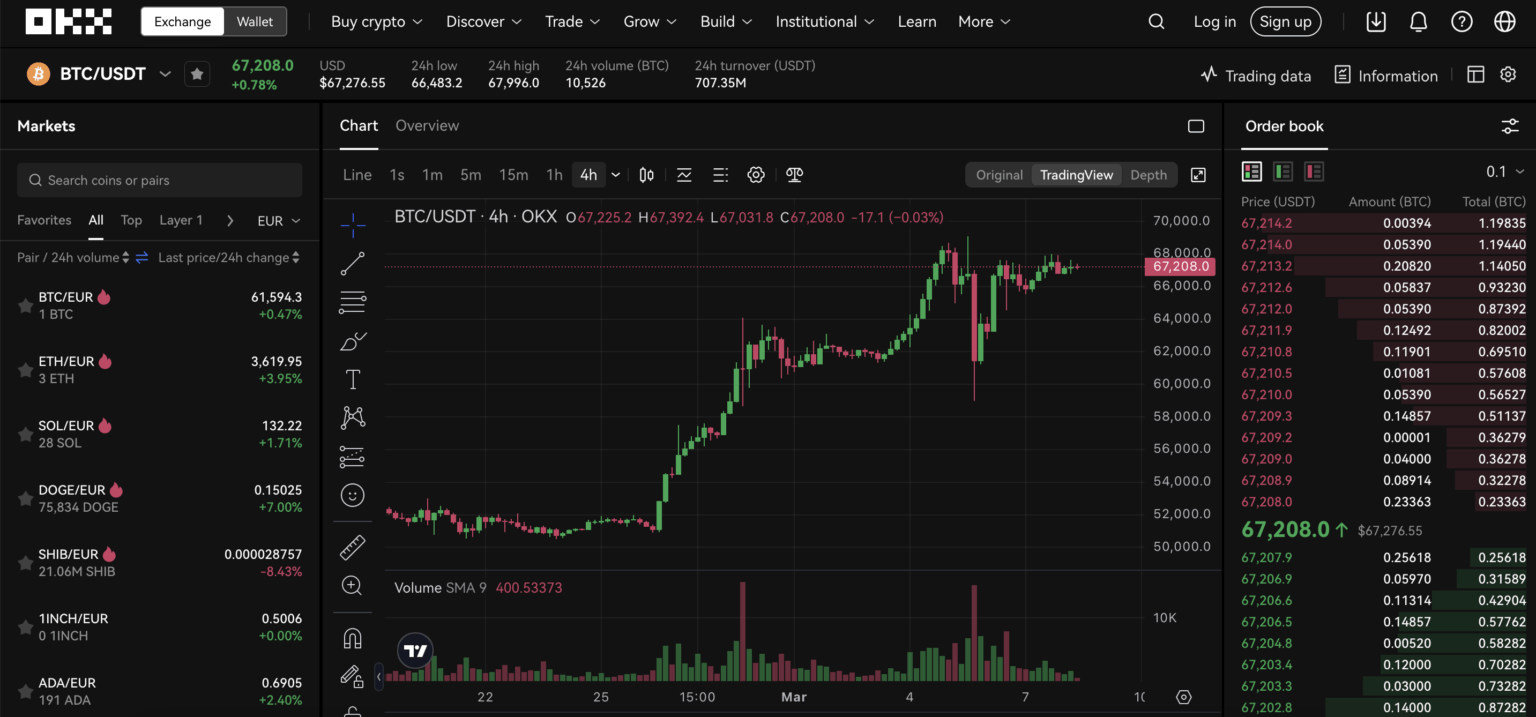
OKX supports multiple entry methods: password plus Two-Factor Authentication (2FA) via SMS or Google Authenticator, biometric methods on mobile apps, and Web3 wallet connections for non-custodial flows. It layers those with server-side protections—military-grade encryption and AI-driven detection that can flag suspicious logins. For US users this combines convenience and regulatory compliance: KYC (identity verification) is mandatory and includes ID upload and a facial liveness check, which influences how quickly you can restore access after lockouts.
Mechanisms matter because they determine your real-world failure modes. SMS 2FA is convenient but vulnerable to SIM-swapping; authenticator apps are safer but require you to preserve the secret across devices. Biometric login on iOS/Android offers speed, but it is device-bound—if you lose the phone you still need recovery routes. The self-custodial Web3 wallet gives you full control of private keys (and full responsibility); if you lose your seed phrase, recovery is typically impossible.
Practical heuristic: use a hardware-backed authenticator (e.g., storing secrets offline or using a hardware security key where supported), enable biometric on your primary device for speed, and keep a tested recovery plan for KYC and seed phrases. For the official web login and troubleshooting, see the OKX web login page: okx.
At a high level: spot trading is buying/selling the actual asset at market price; margin lets you borrow to amplify exposure (OKX supports up to 10x for margin in isolated or cross modes). Futures and derivatives (quarterly, perpetuals, and options) let you take synthetic exposure—both directions—with much higher leverage available on OKX (up to 125x on specific contracts).
Mechanics and implications:
Where each approach breaks:
Think in three dimensions: time horizon, conviction strength, and operational resilience.
– Time horizon: for multi-month to multi-year holdings, spot plus staking/yield is the natural path. For intra-day or swing speculation, futures offer precision but require disciplined risk controls.
– Conviction strength: strong thesis plus tolerance for volatility favors concentrated spot positions; weak or hedged views favor limited leverage or using futures to short without borrowing the underlying.
– Operational resilience: if you cannot tolerate complex recovery from a login problem or a lost 2FA device, avoid highly leveraged futures that need rapid intervention. Conversely, if you can monitor positions and have fast, secure login flows (hardware keys, biometrics, tested 2FA), futures can be a powerful tool.
OKX emphasizes cold storage (over 95% in air-gapped wallets), Proof of Reserves transparency, and AI detection for logins. Those protections reduce systemic counterparty risk but do not eliminate user-level threats: phishing, social-engineering, and loss of seed phrases remain primary causes of permanent loss.
US-based traders should note two practical limits: KYC is required and involves biometric checks, which can complicate anonymous or quick account re-creation; and regulatory dynamics mean features or asset availability can change with regional policy. In short: platform safeguards mitigate some risks, but regulatory friction and user error are residuals you must plan for.
1) Complete KYC early and verify camera/liveness checks on a secure network so you aren’t delayed when you must act. 2) Set up authenticator-based 2FA and test recovery codes; keep them in a secure offline location. 3) For active futures trading, test your login process on the same device you’ll trade from (mobile biometrics or hardware token) and ensure low-latency connectivity. 4) For large spot positions, consider withdrawing to a non-custodial wallet if you plan long-term holding. 5) Use position-size rules: on futures, cap risk per trade to a small percentage of your account to avoid blowing up on a single liquidation.
Myth: “High leverage is just higher upside.” Reality: leverage increases both expected returns and tail risk nonlinearly; even seemingly small price gaps can produce outsized losses when using 50–125x. Myth: “An exchange’s cold storage makes me invulnerable.” Reality: cold storage protects against exchange hacks but not against phishing, account takeover, or regulatory seizures. Myth: “Biometric login is foolproof.” Reality: biometrics improve convenience but create device-bound single points of failure unless paired with robust recovery options.
Use isolated margin when you want to limit the downside to a single pair—it’s safer for speculative positions. Use cross margin when you need flexible collateral across multiple trades, but recognize that a severe move in one asset can liquidate other positions. The rule of thumb: smaller, speculative positions → isolated; diversified hedges or portfolio-level margining → cross (if you can tolerate contagion risk).
Combine an authenticator app (or hardware security key where supported) with mobile biometric login for speed. Keep recovery codes offline and maintain a backup device with the authenticator configured. Test KYC recovery paths ahead of trading—if facial re-verification is required mid-crisis, you don’t want surprise delays. Finally, enable account-level alerts so suspicious login attempts are immediately visible.
Funding rates reflect short-term supply/demand between perpetuals and spot and can be volatile. They are not strictly predictable; monitor order flow, open interest, and macro catalysts. High sustained funding rates indicate an expensive long bias; they matter if you hold leveraged longs across multiple funding intervals.
Yes. For long-term custody, withdrawing to a non-custodial wallet (and optionally storing the seed offline) reduces counterparty risk. Remember: withdrawing incurs on-chain fees and transfers you to the custody model where losing the seed phrase is irreversible.
Monitor three signals: regulatory updates affecting US access or asset listings, changes to margin/leverage policy (which materially affect risk), and liquidity metrics for the instruments you trade. Operationally, watch login-success and 2FA incident reports—if an exchange tightens login controls or changes recovery flows, that can increase friction for legitimate users and should prompt a tested backup plan.
Final takeaway: OKX provides a feature-rich environment—robust custody, many assets, staking and a DEX aggregator—but the most important decisions for US traders are operational. Secure, tested login habits, conservative position sizing on leveraged products, and an explicit plan for recovery and withdrawal separate the traders who survive volatility from those who don’t. Keep mechanisms, not slogans, as your primary mental model: know how access is granted, how positions are maintained, and where the system’s failure modes lie.